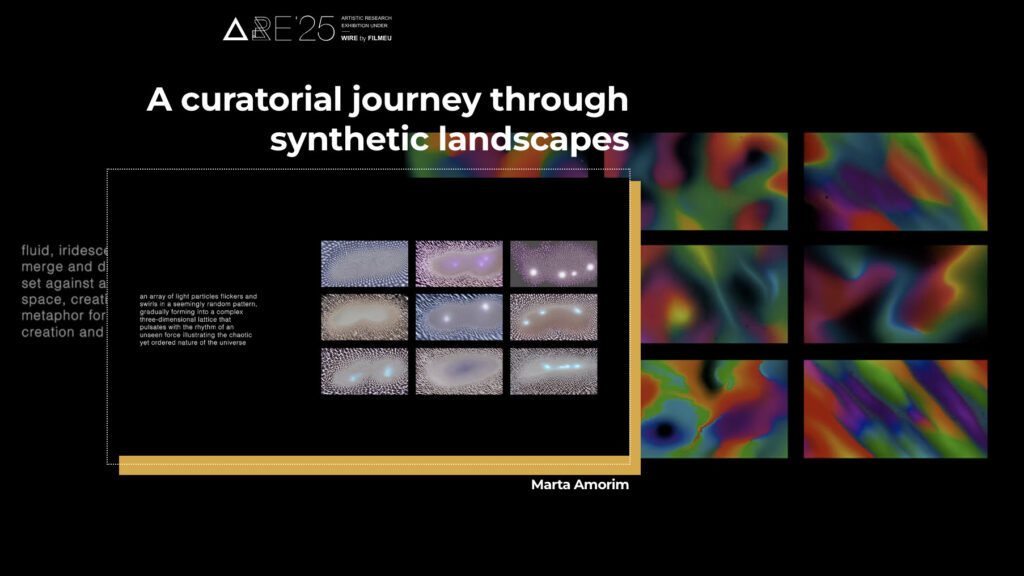
a curatorial journey through synthetic landscapes, 2025
single-channel video
[HD, color, sound]
4’06’’
screenshot from the virtual exhibition
Work presented in the hybrid-format group exhibition Synthetic Rewilding: Between Nature and the Machine, as part of ARE 2025: Artistic Research Exhibition, held in Sofia, Bulgaria [2025].
The video essay a curatorial journey through synthetic landscapes explores the possibility that synthetic landscapes, born of algorithmic abstraction, might be “rewilded” through active human intervention, capable of creating conditions of intelligibility beyond what artificial intelligence alone can produce. In this sense, it reflects on how an authorial gesture can configure formal and temporal relationships within visual matter, in a context shaped by the unpredictability that characterizes these systems, thereby determining the conditions of their reading.
The work foregrounds the complexity inherent in curating outputs produced by generative algorithms, whose operation—grounded in processes of statistical inference and in the learning of visual regularities from large volumes of data—belongs to a regime distinct from that which structures thought in artistic practice. This paradigm of image production requires iterative cycles in which a negotiation with the model’s randomness is established, making visible a form of distributed agency in which authorial decisions are continuously conditioned and reoriented by the machine. It is within this framework that curatorship asserts itself as a critical and artistic act that defines the final visual configuration, not as an exercise in absolute control, but as a contingent practice developed in articulation with the generative mechanism’s potentials and constraints.
From this perspective, the creation of the video was informed by a curatorial approach centered on the construction of a synthetic landscape through the selection of images situated at the threshold between microscopic organic structures and artificial formations. These compositions subtly evoke logics associated with natural processes of growth and transformation, not in their genesis, but in the way they are rendered legible as a whole, favoring a relational and processual reading. In this sense, this visual territory may be understood as the result of the dynamics of an ecosystem of interdependencies, framed by formal and conceptual criteria that delimit and guide the field of possibilities inscribed in the generated material.