With the growing digitalization of the world, we are more surrounded by screens than ever before. Our relationship with images is largely mediated by these devices, which expose us to uninterrupted flows of pixel masses that are impossible to fully assimilate. Visual culture has entered a phase in which it is computers—not humans—that process, select, store, archive, and distribute images.
An image circulating across media and contexts is transformed by different visual languages, software, on-screen framings, modes of installation within the exhibition space, among other factors. Images are in constant transformation, rewriting, re-editing, and reprogramming as they move through these contexts—and at each stage they are visually altered. Starting from a single set of images, the range of possible representations is virtually limitless.
The present work was conceived based on a video intercom system, which [re]produces monochromatic images with a fixed framing, in real time, within a predefined viewing interval. Through an exhaustive study of these images, the project seeks to address questions related to the support and its materiality, as well as the constellation formed by the triad of image-taker, machine, and subject.
The images in this project emerge through the interdependence of media, which are often composed of a combination of technologies: some that reproduce images, others that produce them, and still others that interpret and/or transform them. The chosen means of production and presentation reinforce the idea of constant technological mediation.
There is a “dance” between art, technology, and science, explored here to reveal not only images and their visuality, but also the materiality of their supports and the presence of the apparatuses.
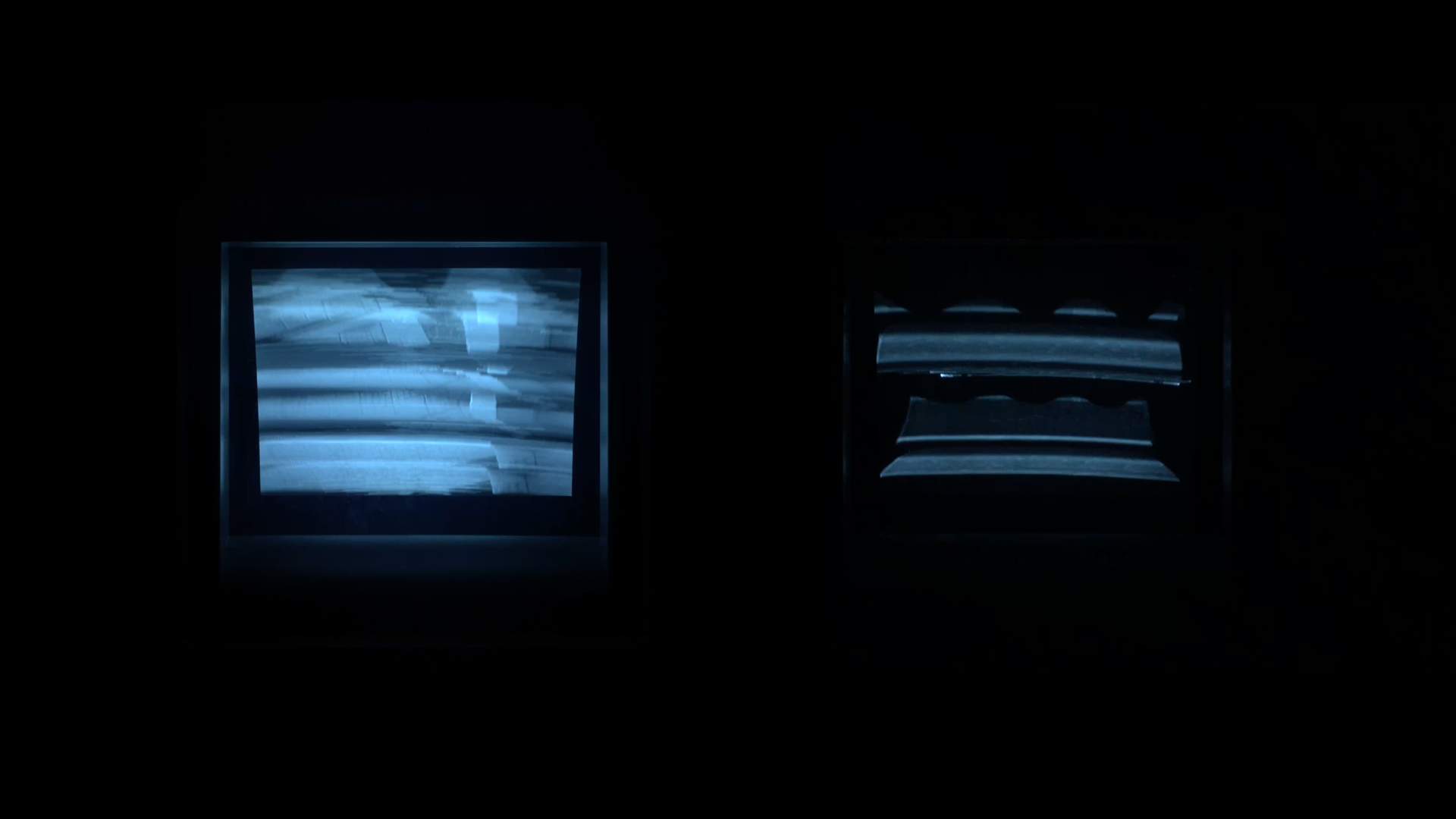
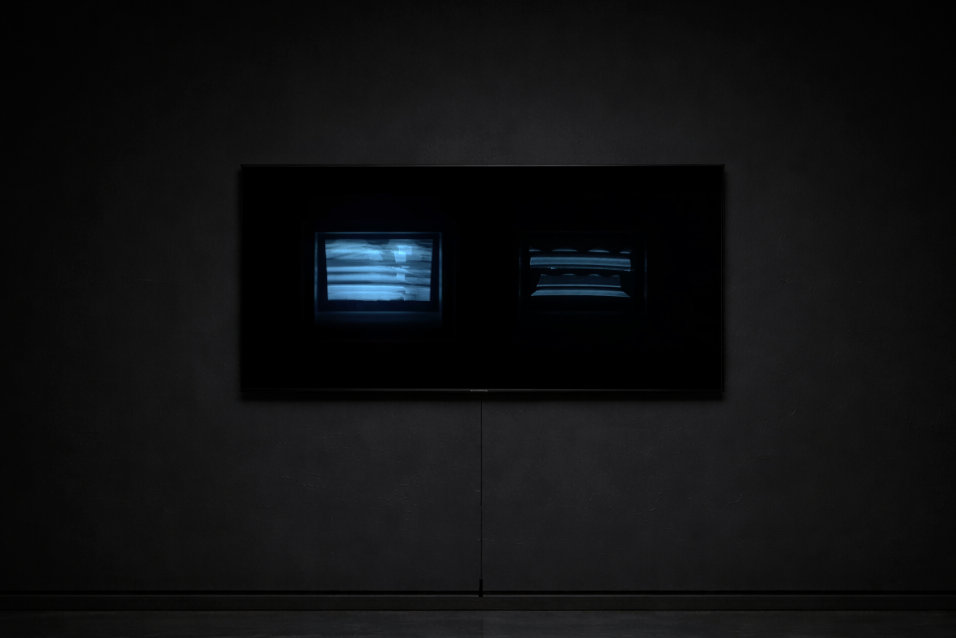
continuous signals, 2019
single-channel video
[4K, 16:9, color, no sound]
loop
installation mock-up
Work presented in playlist#42 part of the project PLAYLIST — Portuguese Video Art Programme, curated by Nuno Ramalho, at Café Candelabro, Porto, Portugal [2020].
If a photograph captures a moment extracted from a sequence of events, by contrast, video has the capacity to record the entirety of the images generated over the course of those events. Within the context of this work, the choice of medium is grounded in this premise: in the moving images it captures, video accumulates a flow of sequential still images that the eye is unable to isolate individually.
Through recording, the aim is to confer permanence on these transient images reproduced on the video surveillance screen, granting them an existence that exceeds the function, time, and place to which they were previously confined.
Stripped of their merely utilitarian charge, these images—[real-time and fixed-frame]—reflect absent actions, devoid of meaning or explicit purpose. By depicting no particular situation, the space they contain loses its materiality. In this negation of action and narrative, what is shown is presented as the image itself. The only “event” lies outside it and manifests in the endless task of periodically activating the screen. An infinite loop is thus created, in which the same image is constantly being redrawn.
Nor is the evident obsolescence of the apparatus irrelevant to this process. It is within this obsolescence, and in the mutations it induces, that the generative focus of interest in the images resides. The distortions produced function as an accretion that adheres to the image, randomly transforming each frame and indefinitely extending the representational possibilities of a single subject.
This superimposition of visuality over scene and subject is grounded in the visual grammar produced by the apparatus itself and in the way it is integrated into the structure of the images. The emphatic manner in which the screen asserts its presence compels an awareness of its effective action upon the physical reality of reproduction. There is a visible loss of image stability, whose cadence suggests an ongoing degenerative process. By ceasing to reproduce a reality, the images come instead to represent visually transmitted electronic stimuli.
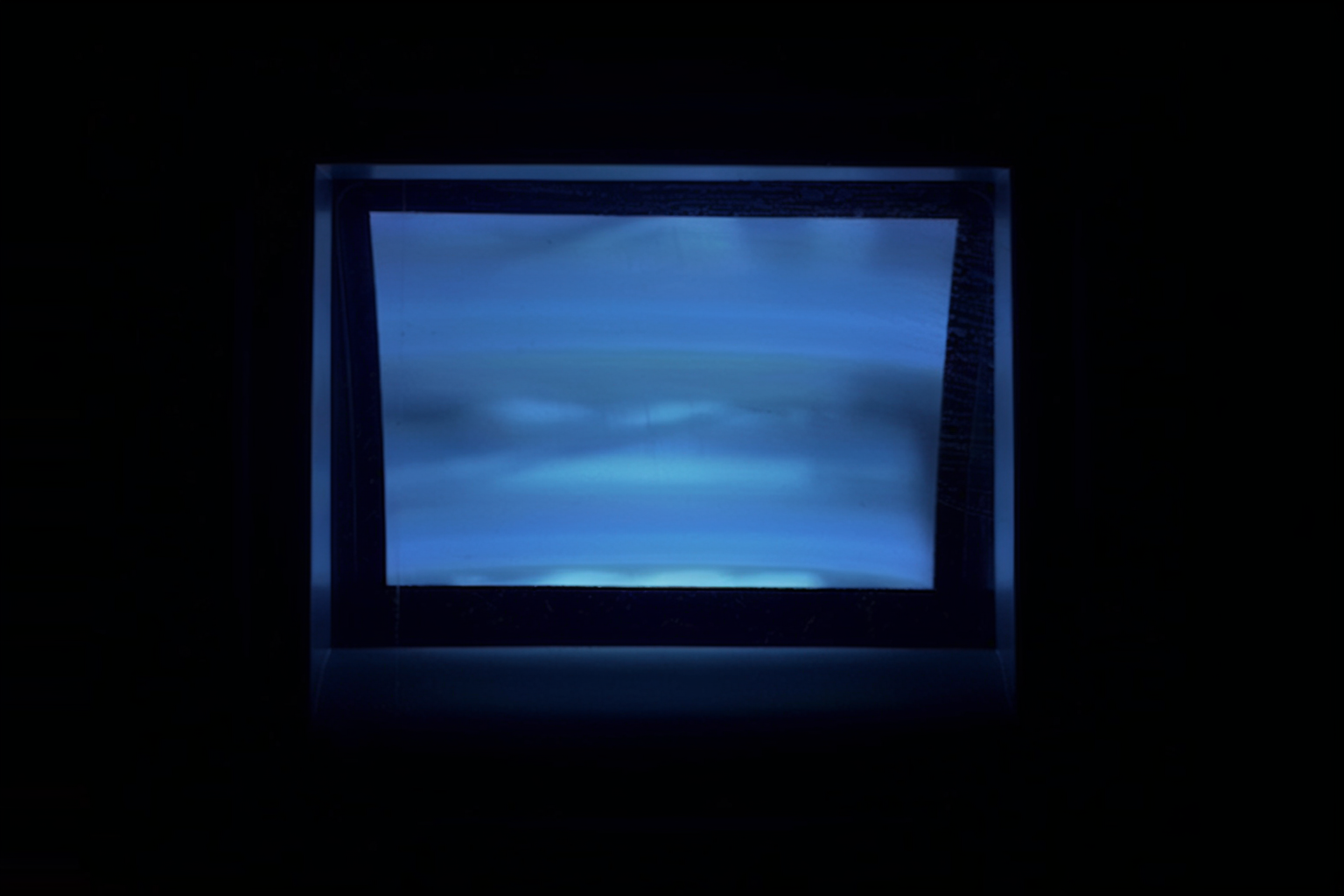

accumulation points, 2020
multi-channel video installation
[5 channels, 4:3, color, no sound]
30’’ loop
installation mock-up
A long exposure assumes that a single photograph can register a sequence of events and contain multiple images within itself. Based on this definition, the possibility was explored that the use of long exposures might bring into visibility the space located by the camera integrated into the video intercom. This attempt at reconstruction sought to reverse the destructive transformations imprinted on the images, mitigating the effects resulting from the device’s operational characteristics and the wear caused by use.
In the course of the exploratory development, this initial hypothesis was abandoned in favor of the process itself, with interest shifting toward the operational characteristics of the software used to capture these long exposures. The software allows the visualization of image accumulation over a predetermined period of time. When the screen is activated by pressing the button on the intercom system, it remains on—due to functional constraints—for only 30 seconds, which is also the duration of each video in the sequence. What we observe in these moving images is the materialization of a procedural gesture. The event, the action represented, is self-referential.
shot noise, 2020
single-channel video
[HD, 16:9, color, sound]
2’11’’
installation mock-up
Work presented in the group exhibition fora inverno, já era primavera, o verão seria glorioso, curated by José Maia and João Terras, held online by Espaço Mira, Porto, Portugal [2020].
The means of image and sound transmission at our disposal are increasingly dominating our connection with the outside world. We live in a society of hyper-communication, a new era marked by the ease and speed with which content is disseminated, from which a paradox emerges: the prevalence of excessive noise in communication, resulting from the colossal volume of information available.
This saturation of information is materialized here in a series of photographic images of the screen of the video surveillance system examined in this project, in which digital noise was deliberately amplified during the capture process. Deprived of any sense of reality and arranged in a uniform sequence, the images are transformed into an indistinguishable, neutral set that resists perceptible reading. The sound—unexpressive, composed of the electronic noise of the capture device—together with the continuous stream of images, creates the impression of a coded recording, highlighting the difficulty we face in absorbing and interpreting the overwhelming flow of images with which we are bombarded on a daily basis.
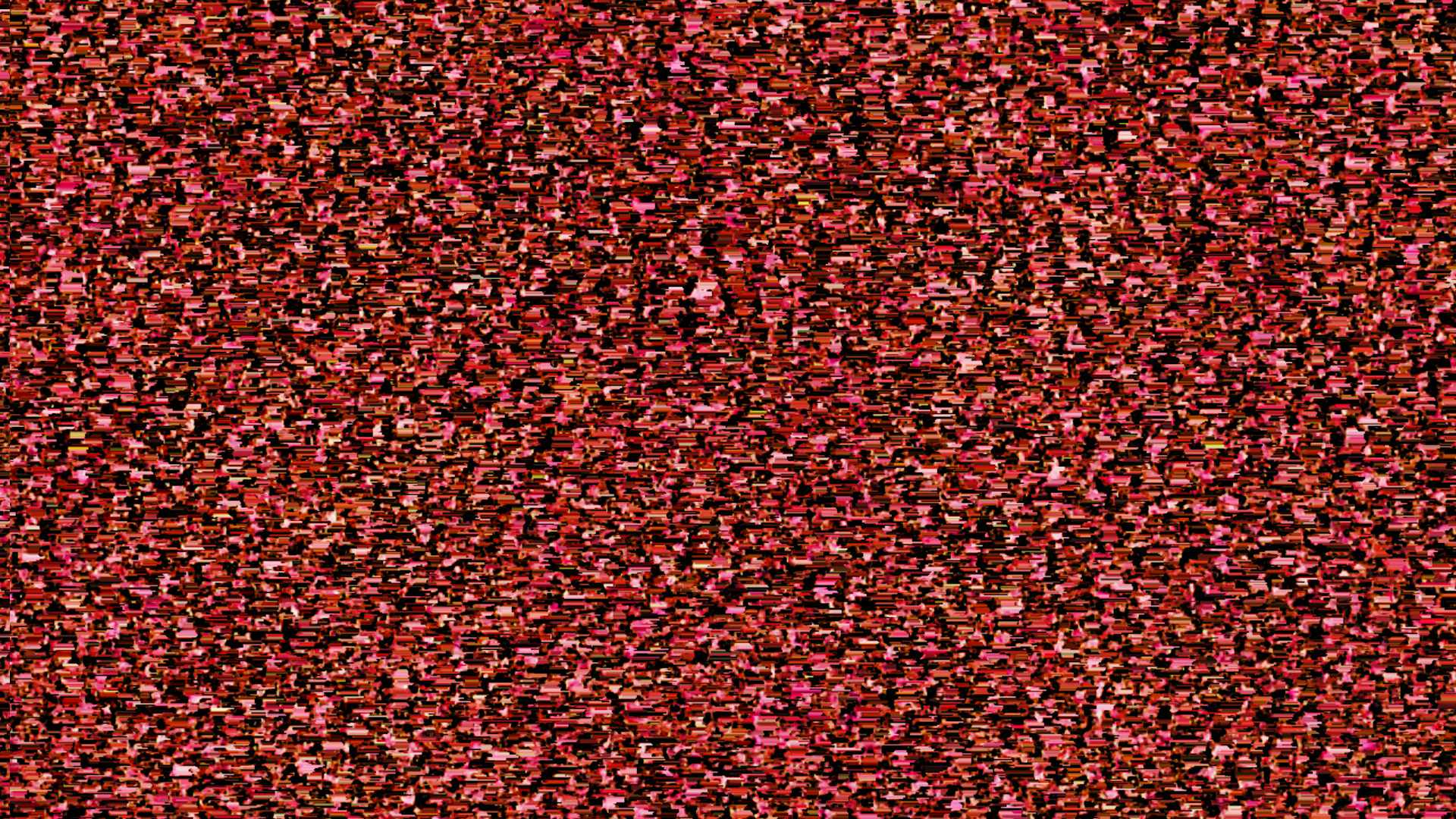

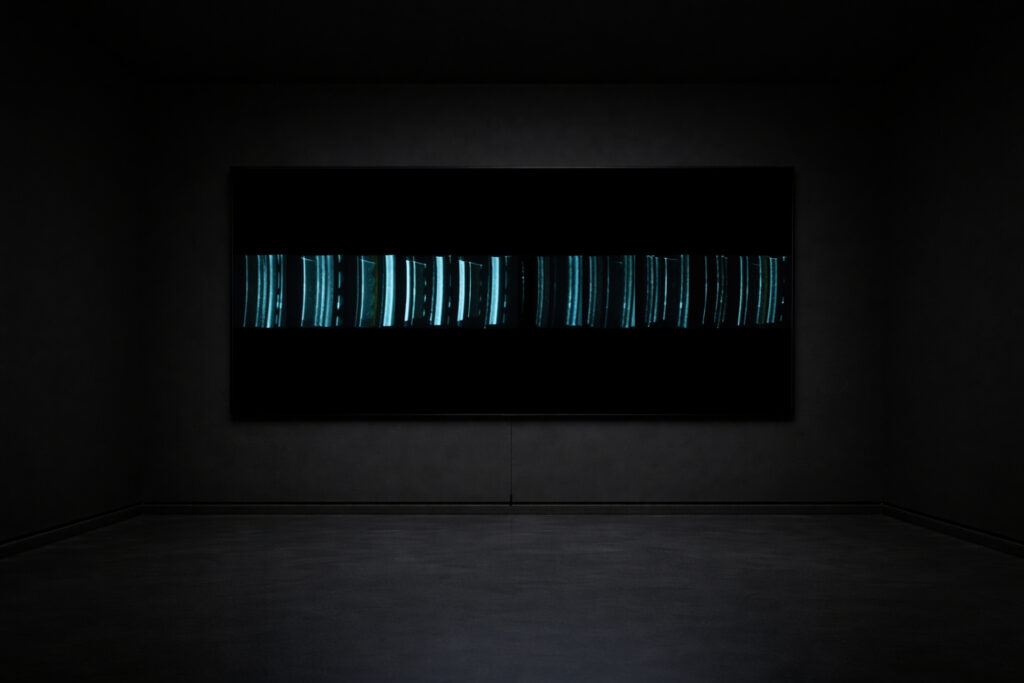
continuous set, 2020
single-channel video for large-scale projection
[HD, 16:9, color, no sound]
loop
installation mock-up
The deepening of the study of representational possibilities begins with frames extracted from videos appropriated from the intercom system. This investigation is closely linked to the issue of variability to which a single image is subjected when presented across different media, whether physical or technological. In the transition—when images cease to be composed of pixels on a screen—they also come to be constituted by the materials used in printing. Whether through the properties of the ink, the structural characteristics of the support, or the interaction between the two, a previously absent materiality is added to them.
Here, the notion of materiality is emphasized through the printed reproduction of the earlier frames on a transparent support, which alludes to the photographic negative. Each image is fragmented into segments equivalent to the conventional strips of film cut from a roll. These “new” images are processed in a negative scanner, a device that “projects” them into a computer, where they are subjected to a set of destructive transformations carried out through software manipulation. The emptying of the subject [and of meaning] is almost total in the images generated in the interstices of this digital system. What remains is only a surface of aggressive luminosity and acute sharpness. It is the return of the image to its pure state, distinct from and almost independent of the world.
To reinforce the idea of circularity present throughout the work, movement is restored to the images in their processed form, thereby closing the cycle. Given that perception changes according to the movement instituted, once a sequential flow of images is established, pure visuality disappears.
The speed at which images are read is the essence of this project. The slow passage of successive, almost identical frames creates the illusion of a continuum: an indistinguishable and neutral amalgam. Yet any attempt to capture a single frame will always produce an image different from the previous ones. The idea of infinity is reinforced by this possibility that, from any fragment of the continuum, new images can be constructed and added, as in an endless loop.
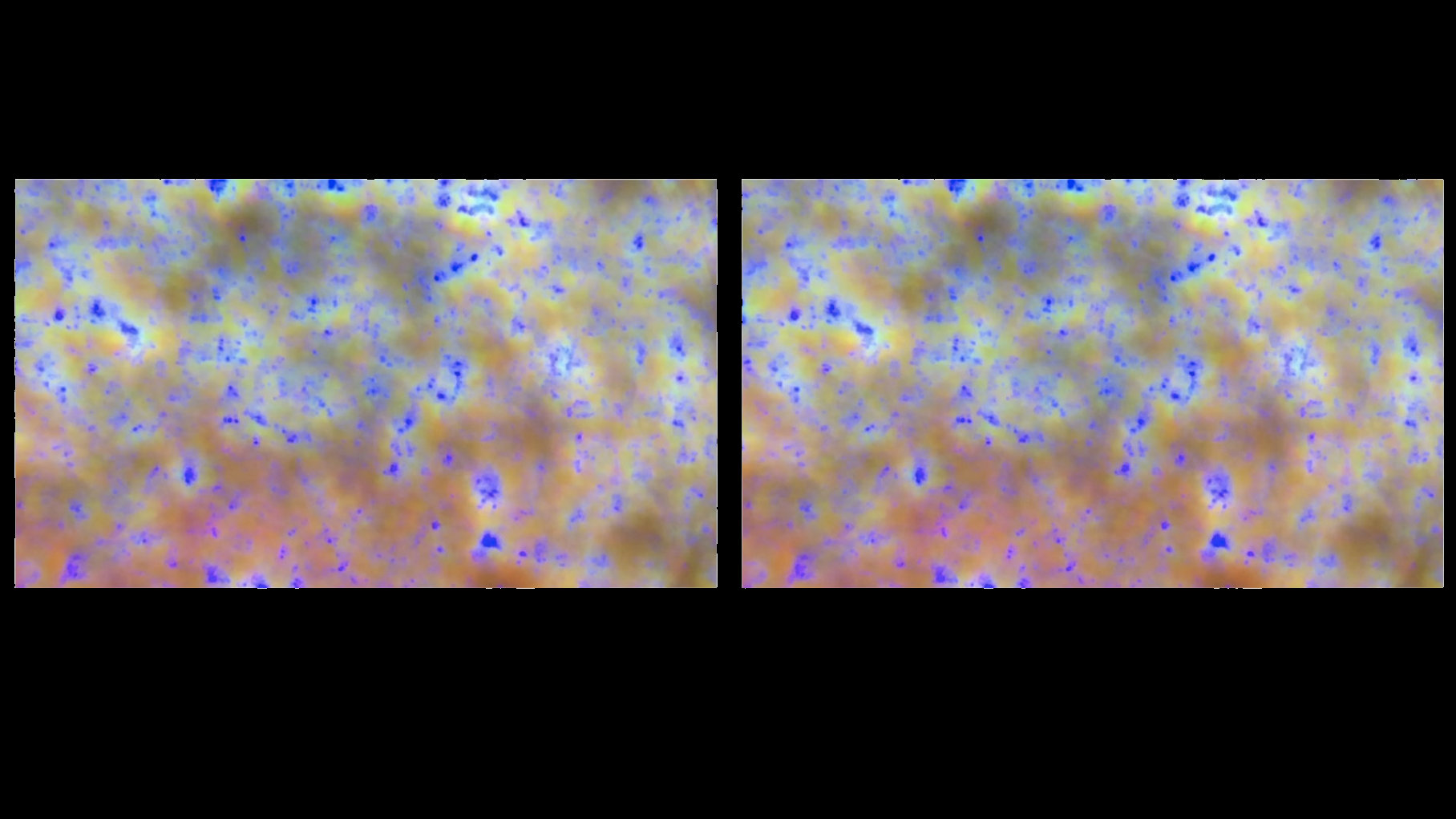
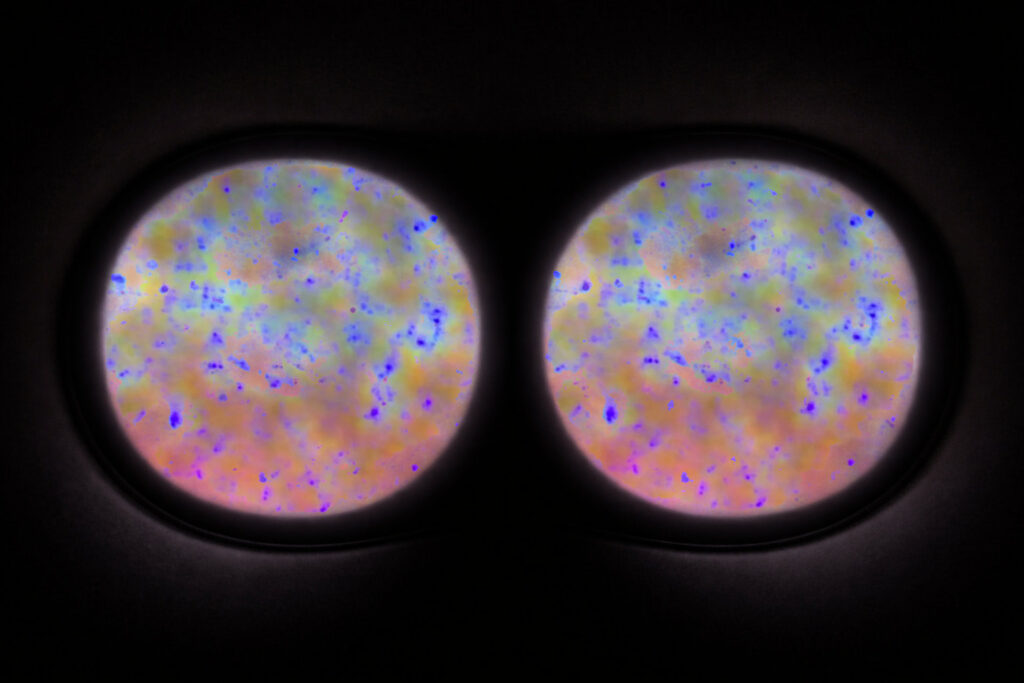
parallax, 2020
stereoscopic video for viewing with virtual reality goggles
[HD, 16:9, color, sound]
loop
mock-up of the stereoscopic viewing device
The microscopic images created for this work and presented in video form belong to a category of apparent invisibility. Their “unconcealment” is only made possible through the integrated use of technologies: the camera lens directed at the microscope’s eyepiece reads small fragments. The progressive segmentation and increasing miniaturization of the subject throughout the project reach their apex here: minute details of reproductions of images obtained in the immediately preceding stage of the work are “analyzed.”
The abstracting character of the images produced, brought about by the radical proximity to the subject, allows their segments to become autonomous from their origin, acquiring a life of their own. Magnification does not merely confer greater clarity on the less perceptible elements of the image; it creates new formulations of the object.
The introduction of movement into the images generates the perception of different planes, as it reveals the multiple layers that compose them. These layers are formed in the transition from the digital to the physical. Once removed from the system in which they were produced—the computer—the images undergo a process of mutation resulting from the integration of new components: ink and support. There is an awareness of the surface.
The acts of focusing and defocusing that animate the images in the video, in addition to revealing stratification, suggest the presence of the apparatus while simultaneously evoking photographic practice. The use of the camera–microscope pairing carries a distinctly scientific connotation, traditionally foreign to the artistic field. Here, the marking of distance from science is ensured by modifying the circular framing characteristic of microscopy; in an attempt to detach or soften the scientific bias of the images, the circular format is transposed into a standardized video format. However, it is not possible to annul the omnipresence of this connection; the overlap between art and science within the images is quite evident.